
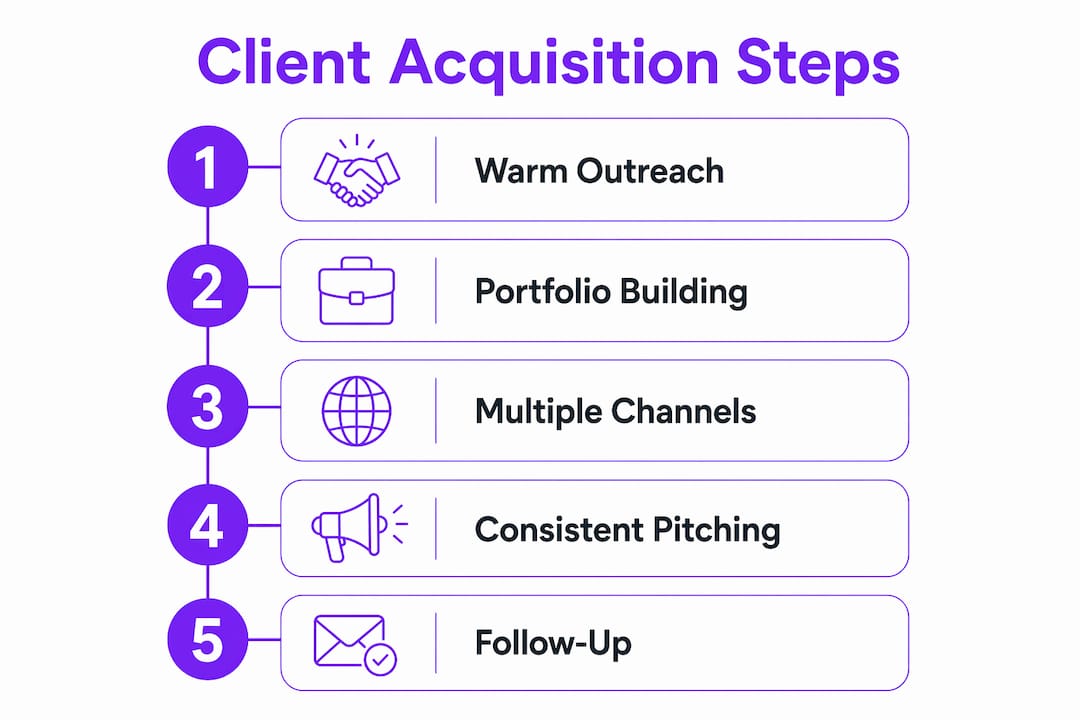
Freelancer client acquisition is the process of identifying, attracting, and converting paying clients through a mix of outreach, referrals, and portfolio proof. Knowing how to get clients as a freelancer separates those who earn consistently from those who scramble between projects. 67% of freelancers secure work through referrals, their existing network, or a personal website. That single fact tells you where to focus your energy first. The remaining 33% rely on freelance platforms, cold outreach, and paid acquisition. Successful freelancers use multiple channels, not just one, to keep their pipeline full year-round.
How to get clients as a freelancer through warm outreach
Warm outreach is the fastest path to your first paid project. Referrals convert at 30%–50%, while cold email averages just 1%–3%. That gap is not a small edge. It is the difference between landing a client this week and spending two months in silence.
Warm introductions, where a mutual contact connects you to a prospect, convert at 20%–40%. The reason is simple: trust transfers. When someone vouches for your work, the prospect skips the skepticism phase entirely. Referred clients also stay 37% longer on average than clients from other sources. That means less time re-acquiring and more time doing billable work.

The most practical tactic for new freelancers is the “30-message rule.” Sending personalized messages to 30 people who already know your work shortens the time to your first client to 3–8 weeks. Relying only on freelance platforms can stretch that timeline to 8–16 weeks. The contacts do not need to be potential clients themselves. They just need to know someone who might need your services.
Here is how to run a warm outreach campaign effectively:
- Write a short, specific message explaining what you now offer and who you help.
- Ask directly: “Do you know anyone who might need this?”
- Follow up once after 5–7 days if you get no reply.
- Keep a simple spreadsheet tracking who you contacted and their response.
- Prioritize people who have seen your work firsthand, such as former colleagues, classmates, or past employers.
Pro Tip: Do not send the same message to all 30 contacts. Reference something specific about each person, such as a project you worked on together or a recent update from their LinkedIn profile. Personalization is what separates a reply from a delete.
What makes a portfolio actually win clients?
A portfolio’s job is to prove capability fast, not to impress with design. A simple portfolio with 3–6 case studies built on Notion, Carrd, or Behance outperforms an elaborate website that takes months to build and has no real work behind it. Prospects spend less than two minutes reviewing a portfolio. Every second you waste on decorative elements is a second they are not reading about your results.
Each case study should follow a tight structure: the client’s problem, what you did, and the measurable outcome. “Redesigned homepage” is weak. “Redesigned homepage that increased sign-ups by 40% in 30 days” is a case study. The outcome is what the client is actually buying.
Pro Tip: Use a branded project portal that combines your deliverables, approval process, contract, and invoice in one place. A polished client portal signals professionalism before you have a long track record. Tools like Notion work well for this setup.
For freelancers who want to build their portfolio faster, Promptlyfreelance offers AI-powered workflow guides that walk you through creating case studies and client-facing documents without starting from scratch.
Which client acquisition channels actually work?
Diversifying across 2–3 acquisition channels creates predictable lead flow and prevents the feast-or-famine cycle most freelancers experience. Each channel has a different time horizon and effort level. Knowing which to use at which stage of your freelance career saves months of wasted effort.
Freelance platforms
Platforms like Upwork give beginners a place to build early portfolio entries and collect reviews. The tradeoff is real: platform pricing often drives a race to the bottom, where you compete on price rather than value. Successful freelancers use platforms early, then shift to direct client relationships for higher pay and full control over their work.
LinkedIn and content marketing
LinkedIn is a long-term channel. Posting consistently about your niche, sharing client results, and commenting on posts from your target clients builds visibility over 3–6 months. The payoff is inbound leads from people who already trust your expertise before they contact you. That trust shortens every sales conversation.
Cold email
Cold email works when it is specific. Personalized, targeted cold emails reach 10%–15% reply rates, compared to 1%–3% for generic templates. The difference is research. A cold email that references the prospect’s recent product launch, a specific gap on their website, or a competitor they are losing to will always outperform a generic “I offer X services” message.
Referral partnerships
Pairing with complementary freelancers, such as a copywriter partnering with a web designer, creates a steady stream of warm referrals from people who already trust your work. These partnerships cost nothing and compound over time. Both parties win by offering clients a more complete service.
| Channel | Best for | Time to first result |
|---|---|---|
| Warm outreach | All experience levels | 3–8 weeks |
| Freelance platforms | Beginners building portfolios | 8–16 weeks |
| LinkedIn content | Established freelancers | 3–6 months |
| Cold email | Targeted niche outreach | 2–6 weeks |
| Referral partnerships | Any level | Ongoing |
How do you pitch clients and close more deals?
The biggest pitching mistake is sending the same message to every prospect. Generic pitches signal that you did not care enough to research the client. Specializing in a niche and positioning yourself as the go-to person for a specific problem increases both acquisition speed and the quality of clients you attract. Generalists struggle to differentiate. Specialists get hired faster and paid more.
Here is a five-step pitch process that converts:
- Research the prospect. Spend 10 minutes on their website, LinkedIn, and recent news before writing a single word.
- Lead with their problem. Open with a specific observation about their business, not a list of your services.
- Show relevant proof. Reference one case study that mirrors their situation. One is enough.
- Reduce their risk. Offer a paid pilot project or a first engagement at approximately 20% below your standard rate to lower the barrier to a yes.
- Ask for the next step. End with a single, clear call to action, such as a 20-minute call, not an open-ended “let me know.”
Follow-up is where most deals are won or lost. Send a polite follow-up after five business days if you hear nothing. A second follow-up after another week is acceptable. After that, move on and revisit in 30 days.
Pro Tip: After every successful project, ask for a referral immediately. Explicit referral requests outperform vague hints every time. A simple message like “Do you know one or two people who might benefit from this?” takes 30 seconds and can generate your next client.
Tracking your outreach in a spreadsheet or CRM, including messages sent, replies, and conversions, turns your acquisition process into something you can measure and improve. Without tracking, you are guessing.
Key Takeaways
Freelancers who combine warm outreach, a results-focused portfolio, and 2–3 diversified acquisition channels build the most reliable and sustainable client pipelines.
| Point | Details |
|---|---|
| Warm outreach converts best | Referrals convert at 30%–50%, far above the 1%–3% rate for cold email. |
| Use the 30-message rule | Contact 30 known people to land your first client in 3–8 weeks. |
| Keep your portfolio tight | Three to six case studies with clear outcomes beat elaborate but empty websites. |
| Diversify your channels | Maintain 2–3 acquisition channels to avoid income gaps between projects. |
| Ask for referrals explicitly | Request referrals immediately after project delivery for the highest response rate. |
Why most freelancers stay stuck longer than they should
The most common mistake I see is over-polishing and under-outreaching. Freelancers spend weeks perfecting a website, refining a logo, or rewriting a bio when they should be sending their first 30 messages. The market does not reward the most polished portfolio. It rewards the person who shows up, communicates clearly, and delivers results.
Warm leads cut the sales cycle in half. First clients almost always come from people who already know your competence, not from cold pitches to strangers. If you are starting out, your network is your most underused asset. Work it before you spend a single dollar on ads or a premium website.
A simple, consistent system beats sporadic bursts of frantic bidding. I have watched freelancers send 50 cold pitches in a panic, get no replies, and conclude that outreach does not work. What actually did not work was the lack of personalization, the absence of follow-up, and the failure to track anything. Build a process, run it weekly, and improve it based on data.
Pricing confidently is also non-negotiable. Underpricing does not attract better clients. It attracts clients who will question every invoice and push back on every revision. Price at a level that reflects real value, and use a modest first-project discount as a deliberate, temporary strategy, not a permanent position.
— Alisha
Promptlyfreelance tools that speed up client acquisition
Getting clients requires the right message at the right time. Writing outreach emails, proposals, and portfolio case studies from scratch takes hours that most freelancers do not have.
Promptlyfreelance provides ready-to-use AI prompts built specifically for freelancer outreach, proposal writing, and portfolio development. The platform’s AI tools for freelancers cover everything from crafting a personalized cold email to structuring a winning project proposal. Freelancers who use Promptlyfreelance’s keyword research prompts also position their services to attract inbound leads from the right clients. The result is less time writing and more time closing.
FAQ
How long does it take to get your first freelance client?
Using the 30-message rule with warm contacts, most freelancers land their first client within 3–8 weeks. Relying only on freelance platforms typically extends that timeline to 8–16 weeks.
What is the best way to find freelance clients quickly?
Warm outreach to existing contacts is the fastest method. Referrals convert at 30%–50%, which is significantly higher than any cold outreach channel.
How many portfolio pieces do you need to attract clients?
Three to six case studies with clear, measurable outcomes are enough. Each case study should show the client’s problem, your solution, and the result.
Should freelancers use platforms like Upwork to get clients?
Upwork is useful for building early portfolio entries and reviews, but it often leads to price competition. Successful freelancers use it as a starting point, then move to direct client relationships.
How do you ask for referrals as a freelancer?
Ask immediately after a successful project delivery. A direct question, such as “Do you know one or two people who might need this?” consistently outperforms vague or indirect requests.