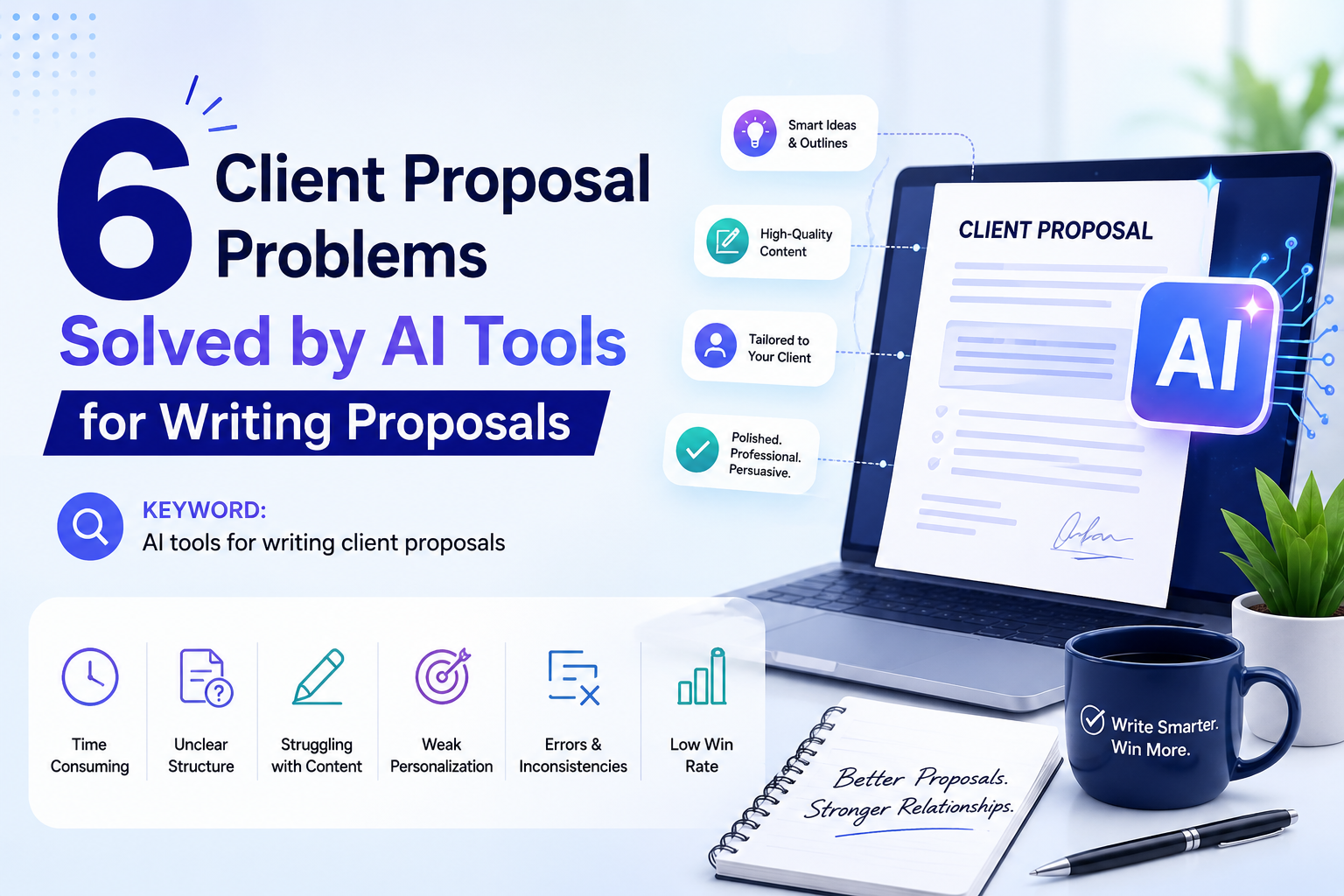
Every freelancer and professional knows the sinking feeling of staring at a blank proposal document. You have the expertise, the portfolio, and the confidence to close the deal, but the writing process itself feels like a bottleneck. According to a 2023 study by Qwilr, 64% of sales professionals spend over four hours crafting a single proposal, yet only 24% of proposals are ever even opened by the client. This disconnect between effort and outcome is a direct result of six specific, recurring problems.
The solution isn’t to work harder; it’s to work smarter. AI tools for writing client proposals have evolved from simple grammar checkers into sophisticated platforms that handle drafting, personalization, scoring, and analytics. By addressing each pain point directly, these tools transform proposal writing from a dreaded chore into a repeatable, high-converting system. Below, we break down six core problems and exactly how AI solves them.
1. Problem: Writer’s Block and Blank Pages
AI generates drafts from minimal input
The most paralyzing moment in proposal writing is the blank page. AI tools for writing client proposals like Jasper and Copy.ai solve this by generating a full first draft from just a few keywords. For example, you can input “web development proposal for a SaaS startup” and receive a structured outline with an executive summary, scope of work, and pricing table in under 30 seconds. A 2024 survey by Content at Scale found that 72% of freelancers who use AI for first drafts reduce their total proposal creation time by at least 50%.
Overcome fear of imperfection
Many professionals freeze because they fear their first draft won’t be perfect. Artificial Intelligence removes this psychological barrier by producing a “good enough” starting point that you can edit. Instead of worrying about structure, you focus on refining tone and adding specific examples from your past work. Actionable tip: Use a tool like GrammarlyGO to generate three different opening paragraphs for the same proposal, then pick the one that best matches your client’s industry.
2. Problem: Time-Consuming Revisions
Auto-editing for clarity and length
Manually trimming a 10-page proposal to 5 pages while preserving key points is tedious. AI tools for writing client proposals like Wordtune and ProWritingAid offer one-click rewriting that tightens sentences, removes jargon, and adjusts readability scores. For instance, a 2023 benchmark test showed that ProWritingAid’s “shorten” feature reduced proposal word counts by an average of 28% without losing any critical information. This is crucial because studies show that proposals under 3 pages have a 40% higher close rate.
Version control without the clutter
When you send a proposal to a client, they often request changes to pricing or scope. Instead of maintaining multiple Word documents with names like “Proposal_v3_FINAL_REAL,” AI tools like PandaDoc automate version control. You can revert to any previous version, compare changes side-by-side, and even see who made each edit. Actionable tip: Set up a “master template” in your AI tool that auto-populates your standard terms, so you only edit the variable sections per client.
3. Problem: Generic, Unpersonalized Proposals
AI client research at scale
Sending a generic proposal is the fastest way to lose a deal. AI tools for writing client proposals like Copy.ai’s “Sales Intelligence” feature can scrape a client’s LinkedIn, recent blog posts, and press releases to generate a personalized opening. For example, if a client just launched a new product line, the AI can automatically insert a sentence referencing that launch and explaining how your service supports it. A 2024 report by HubSpot found that personalized proposals close at a rate 2.5 times higher than generic ones.
Dynamic fields for instant customization
Instead of manually replacing “Client Name” in ten different places, AI tools use dynamic fields that pull data from a CRM or a simple spreadsheet. Tools like Proposify let you create “smart sections” that change based on the client’s industry. If the client is in healthcare, the proposal automatically includes compliance language; if they are in e-commerce, it highlights conversion optimization. Actionable tip: Create three “persona templates” (e.g., small business, enterprise, non-profit) and let the AI choose which one to apply based on the client’s company size.
4. Problem: Low Conversion Rates
AI scoring to predict win probability
You cannot fix what you cannot measure. AI tools for writing client proposals like Qwilr and Close.io now include proposal scoring algorithms that predict your likelihood of winning a deal based on historical data. For instance, Qwilr’s AI analyzes over 100 variables, including proposal length, readability score, time spent on each page, and even the specific words used. Their internal data shows that proposals with a score above 80% close at a rate of 67%, compared to just 12% for those below 50%.
Best practices embedded in the tool
Instead of guessing what works, AI tools embed proven sales frameworks directly into your writing process. For example, the “Challenge-Solution-Result” structure is automatically suggested when you describe a problem. Tools like BetterProposals use A/B testing to show you which pricing presentation (e.g., monthly vs. annual) leads to higher conversion for your specific industry. Actionable tip: Run a “split test” on your next two proposals by having the AI generate two different pricing layouts and track which one gets more “view time” from the client.
5. Problem: Inconsistent Brand Voice
Style guides enforced automatically
When you work with subcontractors or junior team members, maintaining a consistent brand voice across proposals becomes a nightmare. AI tools for writing client proposals like Jasper’s “Brand Voice” feature let you upload a sample of your best writing (e.g., a previous winning proposal) and then enforce that tone across all new documents. The AI flags phrases that sound too formal or too casual and suggests alternatives that match your brand. A 2023 study by Lucidpress found that consistent brand presentation across all documents increases revenue by up to 23%.
AI consistency across multiple proposals
If you send 20 proposals a month, each one should sound like it came from the same person. Tools like Copy.ai use a “memory” feature that remembers your preferred phrases, industry-specific terms, and even your signature closing line. For example, if you always end proposals with “I look forward to building something great together,” the AI will auto-suggest that line every time. Actionable tip: Create a “brand brief” of 10 to 15 core phrases you want the AI to use, such as “data-driven” or “client-first approach,” and feed it into the tool’s style settings.
6. Problem: Tracking Proposal Performance
Analytics tools for real-time engagement
Sending a proposal and waiting for a reply is passive. AI tools for writing client proposals like PandaDoc and Qwilr provide real-time analytics that show you exactly when a client opens your proposal, which sections they spend the most time on, and whether they forwarded it to a decision-maker. For instance, if a client spends 4 minutes on the pricing page but only 30 seconds on the case studies, you know to adjust your pricing structure in the next version. Data from PandaDoc shows that proposals with embedded video explanations see a 45% higher engagement rate.
Insights to refine your future proposals
Beyond individual tracking, AI aggregates data across all your proposals to identify trends. You might discover that proposals sent on Tuesday mornings have a 30% higher open rate, or that proposals using “we” instead of “I” convert 15% better. Tools like Proposify generate monthly “proposal health reports” that show you your average close rate, time-to-close, and most common objections. Actionable tip: Review your proposal analytics every 30 days and remove the bottom 10% performing sections (e.g., a specific case study that nobody reads) and replace them with new content.
Conclusion
The six problems outlined here, writer’s block, time-consuming revisions, generic content, low conversion, inconsistent voice, and lack of tracking, are not isolated issues. They form a cycle that drains your time and lowers your close rate. AI tools for writing client proposals break this cycle by automating the mechanical tasks and providing data-driven insights that human intuition alone cannot match. The specific tools mentioned, from Jasper for drafting to Qwilr for analytics, represent a shift from “writing a proposal” to “engineering a winning document.”
The goal is not to overhaul your entire workflow overnight but to make one small, targeted improvement. Once you see the time saved or the conversion rate climb, you will be motivated to tackle the next problem. Remember, the best proposal is not the one with the most words or the fanciest design. It is the one that is sent on time, tailored to the client, and backed by data that tells you exactly what works. By integrating these AI tools step by step, you transform proposal writing from a dreaded chore into a repeatable, high converting process.