

Freelance marketing is the practice of independently offering marketing services as a business, combining specialized expertise with entrepreneurial discipline to deliver measurable value to clients. The short answer to whether it is worth it: yes, but only under specific financial and professional conditions. Freelance marketing consultants in 2026 earn $65–$150/hour, with top specialists reaching $275,000 annually. That ceiling is real, but so is the floor. Median solo earnings land between $90,000 and $120,000, and reaching those numbers requires treating freelancing as a business, not just a skilled role.
Is freelance marketing worth it financially?
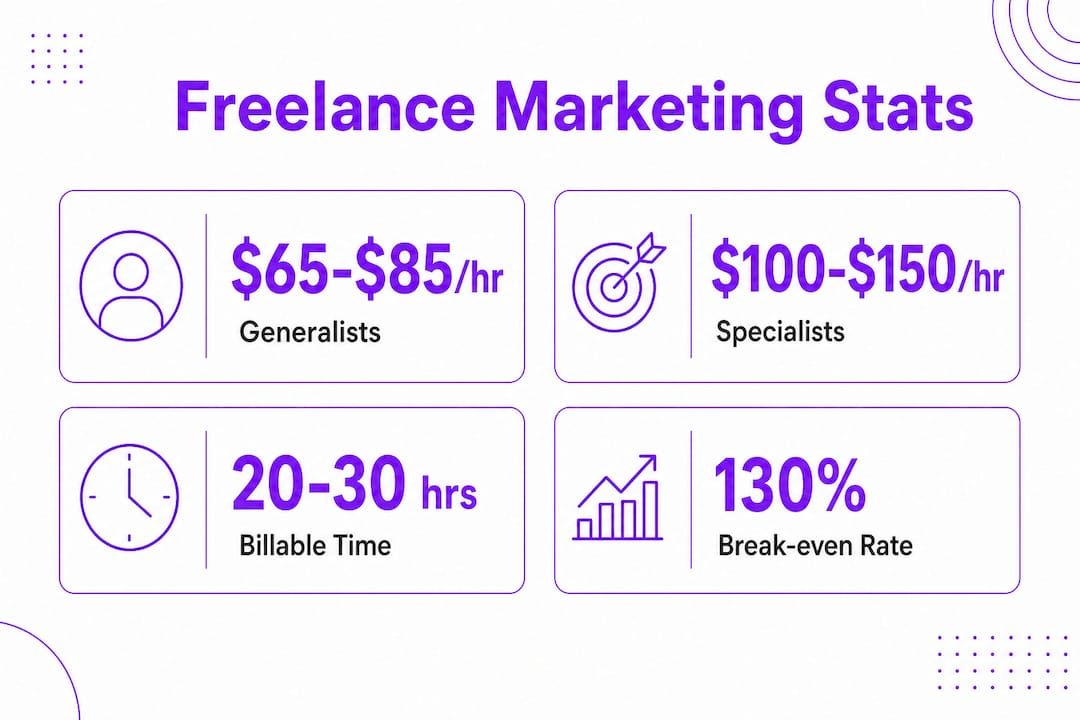
The earnings potential in freelance marketing is real, but the range is wide. Generalists typically earn at the lower end, while specialists and fractional CMOs command the upper tiers. Understanding where you fit in that range is the first step toward making an honest financial decision.
| Role type | Typical hourly rate | Typical annual income |
|---|---|---|
| Marketing generalist | $65–$85/hour | $70,000–$100,000 |
| Niche specialist | $100–$150/hour | $110,000–$175,000 |
| Fractional CMO | $150–$275/hour | $150,000–$275,000 |

The gap between generalist and specialist rates is not cosmetic. Specialists who focus on outcomes like B2B SaaS pipeline growth or e-commerce email revenue can charge two to three times what a generalist charges for the same hours. That premium comes from the client’s perception of reduced risk, not just skill level.
Billing hours also do not equal take-home income. Freelancers typically bill 20–30 hours per week, not 40. Administrative tasks, client calls, and business development consume the rest. A freelancer billing $100/hour for 25 hours per week grosses $130,000 annually before taxes, benefits, and overhead. That number shrinks fast.
Pro Tip: Calculate your annual income target first, then work backward to your required hourly rate. Factor in 20–30 non-billable hours per week before setting your price.
How to determine if freelance marketing is financially viable for you
Financial viability in freelance marketing follows a clear formula. Your market rate must exceed 130% of your employee-equivalent hourly rate to cover taxes, health insurance, retirement contributions, and administrative costs. That 130% threshold is not a suggestion. It is the break-even floor.
Here is a practical self-assessment framework:
- Calculate your employee-equivalent rate. Take your current or target salary, add 30% for employer-side benefits, and divide by 2,080 annual work hours. That is your true cost as an employee.
- Apply the 130% multiplier. Multiply your employee-equivalent rate by 1.3. The result is your minimum viable freelance rate. Anything below that rate means you are earning less than a salaried employee in real terms.
- Account for overhead. Overhead costs consume 30–40% of freelance revenue across healthcare, taxes, and retirement. Budget for these before you set your rates.
- Assess your billable capacity. Realistically, you will bill 20–30 hours per week. Multiply your viable rate by your realistic billable hours to project annual gross income.
- Build your cash reserve. Successful freelancers need 6–12 months of runway and $20,000–$40,000 in cash reserves to handle income gaps without making desperate pricing decisions.
The cash reserve point is often the most underestimated factor. Financial pressure leads to accepting low-paying clients and underpricing proposals. A $20,000–$40,000 reserve gives you the clarity to say no to bad-fit work and hold your rates firm.
Pro Tip: Before going freelance, spend three months tracking every non-billable hour you spend at your current job. That ratio predicts your freelance overhead more accurately than any formula.
What are the major challenges and lifestyle trade-offs in freelance marketing?
Freelance marketing carries real trade-offs that most career guides understate. The challenges are not reasons to avoid freelancing, but they are reasons to prepare seriously before making the leap.
- Feast-or-famine income cycles. The timeline from lead to payment often spans months. A project started in january might not pay until may or later. That lag creates cash flow gaps even when your pipeline looks healthy.
- Non-billable time drain. Freelancers spend 25–35% of work time on administrative tasks such as proposals, invoicing, and client prospecting. That is roughly one full day per week that generates zero revenue.
- Professional isolation. Without a team environment, freelancers miss the informal skill transfer that happens in offices. Peer feedback, collaborative brainstorming, and mentorship do not happen by default. You have to build those networks deliberately.
- Skill stagnation risk. Constant context switching between sales, strategy, and admin creates an invisible drag on productivity and professional growth. Freelancers who do not invest in structured learning fall behind specialists who work inside high-performing teams.
- Client relationship complexity. Managing scope creep, late payments, and misaligned expectations falls entirely on you. There is no account manager or legal team to absorb those friction points.
Freelancing does not eliminate workplace stress. It trades one set of pressures for another. The difference is that you own the outcome, which is both the reward and the risk.
The isolation factor deserves more attention than it typically gets. Many freelancers report that the loss of daily collaboration is the hardest adjustment, not the income variability. Building a peer network through professional communities, co-working spaces, or mastermind groups is not optional. It is a professional survival strategy.
How to build a profitable freelance marketing career
The freelancers who succeed long-term share three traits: they specialize, they price with confidence, and they treat client acquisition as a permanent function of their business. Most successful freelancers have prior in-house experience that provides portfolio work, professional networks, and the credibility needed to command better rates from day one.
Niche down to earn more
Specialization in niche outcomes leads to higher rates and a more defensible market position. General marketing services compete on price. Specialists compete on results. A freelancer who positions as “B2B SaaS email marketing for Series A startups” attracts clients who are willing to pay for precision, not just effort.
Choose your growth model deliberately
Three paths exist for freelance marketers, and each has a different income ceiling and lifestyle profile:
| Model | Income ceiling | Trade-off |
|---|---|---|
| Premium solo | $150,000–$200,000+ | Capped by your hours |
| Productized solo | $120,000–$180,000 | Requires packaging services clearly |
| Agency | $200,000+ (revenue) | Solo consultants earn $188/hr vs. $71/hr per founder hour at small agencies |
The agency path sounds attractive but often reduces your effective hourly income unless revenue exceeds $2 million annually. Most freelancers who scale to small agencies earn less per hour than they did as solo consultants, because payroll and management overhead consume the margin.
Protect your billable time
Use AI tools for freelancers to handle proposals, research, and client communication faster. Automate invoicing and project tracking. Outsource bookkeeping once your revenue justifies it. Every hour you reclaim from admin is an hour you can bill or invest in skill development.
Pro Tip: Treat your freelance proposal process as a product. A templated, polished proposal sent within 24 hours wins more work than a custom document delivered three days late.
Key Takeaways
Freelance marketing is financially worth it when you specialize, price above your 130% break-even threshold, and maintain cash reserves that protect your pricing discipline through income gaps.
| Point | Details |
|---|---|
| Earnings range is wide | Specialists earn $100–$150/hour; generalists earn $65–$85/hour, making niche focus critical. |
| 130% rate threshold matters | Your freelance rate must exceed 130% of your employee-equivalent rate to cover overhead and taxes. |
| Cash reserve is non-negotiable | Keep $20,000–$40,000 in reserve to avoid desperate pricing during slow months. |
| Admin time reduces income | Non-billable tasks consume 25–35% of work time; protect billable hours with tools and systems. |
| Agency scaling often backfires | Solo consultants earn more per hour than small agency founders unless revenue tops $2 million. |
The uncomfortable truth about freelance marketing freedom
By Alisha
The marketing industry romanticizes freelancing. The pitch is always about freedom: set your own hours, choose your clients, work from anywhere. That pitch is not wrong, but it leaves out the part where you are also the sales team, the finance department, the IT support, and the HR manager.
What I have observed after years of watching freelancers succeed and fail is this: the ones who thrive do not love freelancing because of the freedom. They thrive because they love building a business. That distinction matters more than any rate benchmark or income projection.
The financial math is actually the easy part. You can run the 130% calculation in ten minutes. The harder question is whether you have the temperament to prospect for clients when you are already busy, to hold your rates when a client pushes back, and to invest in your own skills when no employer is paying for your training.
My honest take is that freelance marketing is worth it for people who are already good at marketing and want to be rewarded directly for that skill. It is not worth it for people who are escaping a bad job and hoping freelancing will feel easier. It rarely does. What it offers is a direct line between your effort and your income, with no ceiling and no safety net.
Start with a full-time role, build a portfolio and a network, then make the move with cash in the bank and a niche already defined. That sequence works. Skipping steps is where most freelancers run into trouble.
— Alisha
Tools that give freelance marketers a real edge
Freelance marketing success depends on how efficiently you run your business, not just how well you execute campaigns.

Promptlyfreelance is built specifically for freelancers who want to work faster without sacrificing quality. The platform offers ready-to-use AI prompts for client outreach, proposal writing, and content creation, cutting the time you spend on non-billable tasks. Step-by-step tutorials cover everything from using ChatGPT as a freelancer to setting up AI-powered workflows that keep your pipeline moving. If you are serious about making freelance marketing profitable, the right tools reduce the admin drag that eats into your billable hours. Visit Promptlyfreelance to see what fits your workflow.
FAQ
What does a freelance marketing consultant earn on average?
Freelance marketing consultants in 2026 earn a U.S. national average of $75/hour, with median annual income between $90,000 and $120,000. Top specialists in high-demand niches can reach $275,000 annually.
How many hours per week do freelance marketers actually bill?
Most freelance marketers bill 20–30 hours per week, not 40. Administrative tasks, prospecting, and client management consume the remaining time, which directly limits gross income.
Is freelance marketing profitable for beginners?
Freelance marketing is harder to profit from without prior in-house experience. Beginners tend to underprice their services and struggle with client acquisition because they lack a portfolio and professional network.
What is the biggest financial risk in freelance marketing?
The biggest financial risk is income variability combined with insufficient cash reserves. A project started in one month may not pay for several months, creating cash flow gaps that force poor pricing decisions.
How do I know if my freelance rate is high enough?
Your freelance rate is viable when it exceeds 130% of your employee-equivalent hourly rate. That multiplier covers taxes, health insurance, retirement, and the administrative overhead that consumes 30–40% of your revenue.