

A freelance marketing strategy is a repeatable system for attracting, qualifying, and converting ideal clients. Without one, you market in bursts during slow periods and stop the moment work picks up. That cycle keeps your income unpredictable. The good news: 56% of freelancers connect with clients through networking, and 62% rely on referrals and repeat business. Those numbers show that relationships, not advertising spend, drive sustainable freelance growth. The right plan turns those relationships into a structured, measurable pipeline.
What are the core pillars of a freelance marketing strategy?
A successful freelance marketing system rests on four pillars: positioning, visibility, relationship building, and operational discipline. Each one supports the others. Remove any single pillar and the whole structure weakens.
Positioning defines who you serve, what problem you solve, and why a client should choose you over anyone else. A copywriter who says “I write for SaaS companies navigating product-led growth” wins more conversations than one who says “I write for tech companies.” Specificity signals expertise and filters out poor-fit clients before a single call is booked.

Visibility means showing up consistently where your ideal clients already spend time. You do not need to be everywhere. You need to be present and recognizable on the two or three channels your best clients actually use. Consistent visibility on relevant platforms creates familiarity, and familiarity makes sales conversations warmer from the start.
Relationship building extends your marketing beyond the first contact. A prospect who is not ready to hire today may be ready in six months. Staying in touch through a newsletter, a LinkedIn comment, or a brief check-in email keeps you top of mind without being pushy.
Operational discipline is the pillar most freelancers skip. It covers how you manage leads, qualify prospects, write proposals, set pricing, and follow up. Without it, the other three pillars generate interest you cannot convert.
- Positioning: define your niche and your client’s core problem
- Visibility: pick 1–2 channels and show up on a fixed schedule
- Relationship building: follow up with warm contacts every 30 days
- Operational discipline: track leads, proposals, and revenue weekly
Pro Tip: Write your positioning statement in one sentence before you touch any marketing channel. If you cannot explain your value clearly, no channel will fix that gap.
How to build a one-page freelance marketing plan
A one-page marketing plan reviewed monthly is the most direct way to turn goals into repeatable weekly actions. The format forces clarity. You cannot hide vague intentions in a one-page document.
Build yours in five steps:
- Define your target client. Name the industry, company size, and job title of the person who signs the check. “Mid-size e-commerce brands with a marketing manager” is specific enough to guide every decision below it.
- Write your core offer. State what you deliver, the outcome it produces, and the timeframe. “I write email sequences that increase repeat purchase rates within 90 days” is a core offer. “Email copywriting” is a service category.
- Choose your channels. Start with one to two channels and master them before adding more. Adding a third channel before the first two produce data is a common way to dilute results.
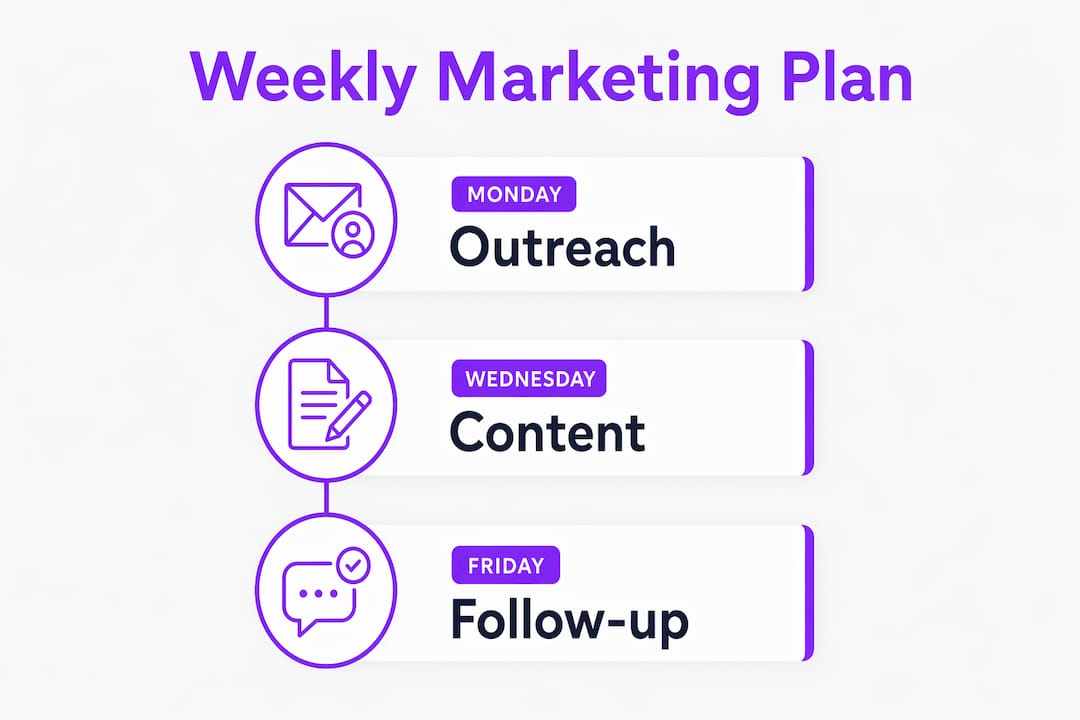
- List your weekly actions. Assign specific tasks to specific days. “Send three LinkedIn connection requests on Monday, publish one case study post on Wednesday, follow up with two warm contacts on Friday” beats “do LinkedIn stuff.”
- Set a monthly review date. Block 60 minutes on the last Friday of each month to check your numbers and adjust.
Pro Tip: Block your marketing time on your calendar before you schedule any client work. Treat it like a client meeting you cannot cancel.
The table below shows a simple weekly cadence you can adapt to your own channels.
| Day | Activity | Time block |
|---|---|---|
| Monday | Outreach: 3 new contacts | 45 minutes |
| Wednesday | Content: 1 LinkedIn post or article | 60 minutes |
| Friday | Follow-up: 2 warm contacts, pipeline review | 30 minutes |
Which marketing channels work best for freelancers?
The best channel is the one your ideal clients actually use, and the one you will maintain for at least six months without burning out. That said, some channels consistently outperform others for freelancers in the United States.
Referrals and networking remain the top source of freelance work. The data is clear: 62% of freelancers find projects passively through referrals or recruiters. That figure means your existing relationships are your most productive marketing asset, and most freelancers underinvest in them.
LinkedIn is the strongest social platform for freelancers targeting business clients. LinkedIn delivers 80% of B2B social leads with better conversion rates than other social platforms. A well-optimized profile, two posts per week, and consistent engagement with your target audience’s content will outperform sporadic posting on five platforms.
Content marketing through a blog, newsletter, or podcast builds authority over time. The honest caveat: inbound marketing requires 6–12 months of consistent effort before it generates steady qualified inquiries. That timeline surprises many freelancers who expect fast results. Plan for it and you will not abandon the channel too early.
Your portfolio functions as a sales tool, not a gallery. An effective portfolio shows the client’s problem, your approach, and the measurable result. “Rewrote onboarding emails; trial-to-paid conversion increased by 18%” tells a story. A screenshot of the email does not. You can find detailed guidance on building a client-winning portfolio at Promptlyfreelance.
Use this channel framework to prioritize your effort:
- Lead channel: your primary source of new clients, worked weekly
- Simmer channel: a secondary channel maintained with lighter effort
- Bonus channels: anything else that produces leads without requiring scheduled time
The biggest mistake in channel selection is trying to be active everywhere at once. Freelancers who focus on one lead channel and one simmer channel consistently outperform those who spread effort across five platforms with no depth on any of them.
How to maintain operational discipline for consistent results
Freelancers who treat marketing as a scheduled business function experience greater stability than those who market reactively. Reactive marketing, the kind triggered by an empty pipeline, produces desperate outreach and poor client fit. Scheduled marketing produces warm conversations and better projects.
The first discipline is tracking outcomes, not activities. Sending 20 cold emails is an activity. Booking two discovery calls from those emails is an outcome. Tracking metrics like leads generated, calls booked, and proposal conversion rates gives you data to improve. Without those numbers, you are guessing which efforts actually work.
The second discipline is qualifying clients before you invest time in proposals. Set intake gates: does the project fit your niche, do the commercial terms work for you, does the timeline match your capacity, and does the client have clear decision-making authority? Freelancers who enforce intake criteria protect their margins and avoid scope creep before it starts.
The third discipline is pricing that reflects your expertise. Underpricing attracts clients who treat you as a commodity and negotiate hardest. Setting rates that reflect the value you deliver attracts clients who respect your work and refer others like themselves.
- Track leads, calls, proposals, and wins every week
- Review your numbers monthly and adjust one variable at a time
- Qualify every prospect before writing a proposal
- Set pricing based on client outcomes, not hours worked
- Follow up on every proposal within five business days
Pro Tip: If you are too busy with client work to market, you are already in trouble. Protect at least two hours per week for marketing, no matter how full your calendar looks.
Key Takeaways
A freelance marketing plan built on positioning, consistent channel focus, and weekly operational discipline produces more qualified leads than any amount of scattered activity.
| Point | Details |
|---|---|
| Define your positioning first | A clear niche and specific offer make every channel more effective from day one. |
| Focus on 1–2 channels | Mastering two channels before expanding produces better data and stronger results. |
| Referrals are your top asset | 62% of freelancers find work passively; nurture existing relationships every 30 days. |
| Track outcomes, not activities | Measure leads, calls, and proposal wins weekly to make decisions based on real data. |
| Schedule marketing before client work | Blocking fixed marketing time prevents the feast-or-famine cycle that stalls growth. |
Why most freelancers market wrong (and how to fix it)
After watching hundreds of freelancers build and stall their businesses, the pattern is always the same. Marketing gets treated as the thing you do when work dries up. You send a flurry of LinkedIn messages, update your portfolio in a panic, and reach out to old contacts you have not spoken to in a year. Then a project comes in and you stop completely. Six months later, the cycle repeats.
The fix is not a better tactic. It is a mindset shift. Marketing is not a rescue operation. It is a business function, like invoicing or client communication, that runs on a fixed schedule regardless of how busy you are. The freelancers I have seen build genuinely stable businesses all share one habit: they market on a schedule, even when they do not need to.
The other trap I see constantly is channel overload. A freelancer launches a newsletter, a LinkedIn presence, a podcast, a blog, and a cold email sequence in the same month. None of them get enough attention to produce results. The freelancers who win pick one lead channel, work it with real consistency for six months, and only add a second channel once the first one produces reliable data.
Clear messaging matters more than most freelancers realize. If a prospect cannot understand what you do and who you do it for within ten seconds of reading your profile or website, they move on. Specificity in your offer is not limiting. It is the thing that makes you memorable. Treat your marketing like the business function it is, and the results will follow.
— Alisha
Promptlyfreelance: tools built for your freelance marketing plan
Executing a freelance marketing plan takes more than good intentions. You need the right tools to write proposals faster, research keywords, and build outreach messages that actually convert.
Promptlyfreelance is built specifically for freelancers who want to work smarter. The platform offers ready-to-use AI prompts for client outreach, proposal writing, and content creation, so you spend less time staring at a blank page and more time in front of clients. Whether you need help with AI-powered proposal writing or want to sharpen your keyword research with AI, Promptlyfreelance has step-by-step guides built around the real challenges freelancers face. Visit Promptlyfreelance to put your marketing plan into action today.
FAQ
What is a freelance marketing strategy?
A freelance marketing strategy is a repeatable system for attracting, qualifying, and converting ideal clients through defined positioning, consistent channel activity, and disciplined follow-up. It replaces reactive, panic-driven outreach with a scheduled, measurable process.
How many marketing channels should a freelancer use?
Start with one lead channel and one secondary channel. Focusing on 1–2 channels before expanding produces better execution quality and more reliable data than spreading effort across multiple platforms at once.
How long does inbound marketing take to work for freelancers?
Inbound marketing requires 6–12 months of consistent effort before it generates a steady flow of qualified inquiries. Plan for that timeline so you do not abandon the channel before it compounds.
What metrics should freelancers track in their marketing plan?
Track leads generated, discovery calls booked, proposal conversion rates, and revenue by channel. Tracking these outcome-focused KPIs gives you the data to improve your plan each month rather than repeating what does not work.
Why are referrals so important for freelance client acquisition?
Referrals produce warm leads who already trust you through a third party, which shortens the sales cycle significantly. 62% of freelancers find projects passively through referrals or recruiters, making relationship maintenance the highest-return marketing activity available.