
The strongest content creation examples for freelancers in 2026 share one thing: they match format to purpose, then let AI handle the production lift. Whether you’re building awareness or closing a client, the format you choose matters as much as what you say.
Here are the formats worth knowing:
- Short-form video (TikTok, Instagram Reels, YouTube Shorts): short videos with quick hooks at the start
- Blog posts and long-form guides: how-to articles, listicles, and pillar content optimized for search
- Email newsletters: direct audience ownership, high engagement, easy to repurpose from existing content
- Podcasts: low barrier to entry, especially if you already produce video (the audio is already there)
- Case studies: before-and-after format that builds trust and aligns with Google’s E-E-A-T framework
- Infographics and data visuals: shareable, citation-friendly, and fast to produce with AI image tools
- AI-assisted content: narration, translation, image generation, and summarization now standard in production pipelines
Each of these formats serves a different job. The freelancers who get the most traction pick two or three and go deep, rather than spreading thin across all of them.
Table of Contents
- How different content formats map to your marketing funnel
- How AI fits into a real freelance content workflow
- What actually separates high-performing content from average content
- Promptlyfreelance gives you the prompts, not just the advice
- Key Takeaways
How different content formats map to your marketing funnel
Not every piece of content does the same job. Content formats align with funnel stages, and knowing which format fits which stage keeps you from writing a conversion-focused case study when your audience has never heard of you.
| Funnel Stage | Goal | Best Content Formats | Typical Length/Format |
|---|---|---|---|
| Awareness | Educate, attract new readers | How-to blog posts, short-form video, infographics, podcasts | Moderate-length blog posts and short videos with quick hooks |
| Consideration | Build trust, compare options | Long-form guides, comparison articles, webinars, newsletters | In-depth articles and medium-length webinars |
| Decision | Convert, close | Case studies, testimonials, proposals, product demos | Focused and specific written content |
A how-to guide explaining “how to price freelance services” targets awareness. A case study showing a freelancer who doubled their rate after using a specific workflow targets decision. The structure of each piece follows from that intent. How-to guides for awareness and case studies for decision stages is the default mapping most experienced content strategists use.
Content expert Tabitha Whiting notes that organizing content by purpose, rather than format alone, is what separates strategic creators from those just filling a calendar. Her 2026 content marketing types guide shows brands like Ravio building entire content ecosystems around a single audience problem, covering awareness listicles, comparison guides, and evaluation frameworks under one topic umbrella.

Pro Tip: Before writing anything, ask: is this piece meant to introduce, convince, or convert? That single question determines format, length, and the call to action.
How AI fits into a real freelance content workflow
AI-assisted formats like narration, translation, and image generation are now standard inputs in content production. The practical question isn’t whether to use AI. It’s where in your workflow it saves the most time.
Here’s where freelancers are getting the most value:
- Repurposing: turn a 2,000-word blog post into a newsletter, three LinkedIn posts, and a short-form video script using a single AI prompt
- AI narration: convert written guides into audio content without recording equipment
- Image generation: tools like Midjourney produce custom visuals for blog headers, social posts, and infographics in minutes (see Promptlyfreelance’s guide on using Midjourney as a freelancer)
- Translation: reach Spanish-speaking or international clients without hiring a translator
- Summarization: compress long research into tight briefs before writing, cutting research time significantly
- Prompt-driven drafts: structured prompts for specific formats (case study, newsletter, proposal) produce usable first drafts in under ten minutes
The best AI assistant practices emphasize keeping humans in the strategic seat. AI handles production efficiency; you handle the judgment calls about tone, audience, and what actually needs to be said. That division is what separates content that feels human from content that reads like it was assembled.
Question-led headings and direct-answer summaries also improve how AI search engines extract and cite your content. Structure each section so the answer comes first, then the support. Short paragraphs, clear Q&A blocks, and FAQPage schema markup all increase citation likelihood in tools like ChatGPT and Perplexity.
For freelancers doing keyword research with AI prompts, the same structured-prompt approach applies: specific inputs produce specific outputs. Vague prompts produce generic content nobody wants to read.
What actually separates high-performing content from average content
Format and AI tools get you to the starting line. What wins is execution. Strong hooks, specificity, and platform-native adaptation are the three traits that consistently separate content that earns attention from content that gets scrolled past.
Hooks that work don’t warm up. A TikTok that opens with “Today I want to talk about…” is already losing. A LinkedIn post that leads with a counterintuitive claim or a specific number pulls readers in before they decide to scroll.
Specificity beats generality every time. “I increased my freelance income” is forgettable. “I raised my rate from $65 to $120 per hour after restructuring my proposals” is citable, shareable, and trustworthy. Case studies with named, specific outcomes build the kind of authority that generic posts never will.
Platform adaptation means more than resizing a graphic. A LinkedIn post has a professional register; a TikTok video lives or dies on its first three seconds; a newsletter rewards depth because the reader opted in. The same core idea needs a different entry point on each platform.
“Successful freelancers tailor content strategies around their unique strengths and audience needs rather than chasing all formats. No universal formula exists; strategic alignment on content purpose drives results.” — Content Marketing Institute
Tracking performance closes the loop. The metrics worth watching depend on the funnel stage: organic traffic and impressions for awareness content, time-on-page and email open rates for consideration, and conversion rate or direct inquiries for decision-stage pieces. Freelancers who track these consistently can see which formats are actually generating clients, not just views.
Strategic planning means choosing formats based on where your strengths are, not where the trends are. A freelancer who writes well but hates being on camera will produce better results from a newsletter than from a YouTube channel, even if video is “what’s working” right now. Creator success comes from building around your strengths and your audience’s preferences, not from copying someone else’s format stack.
Promptlyfreelance gives you the prompts, not just the advice
Most content advice tells you what to create. Promptlyfreelance gives you the actual tools to create it faster.
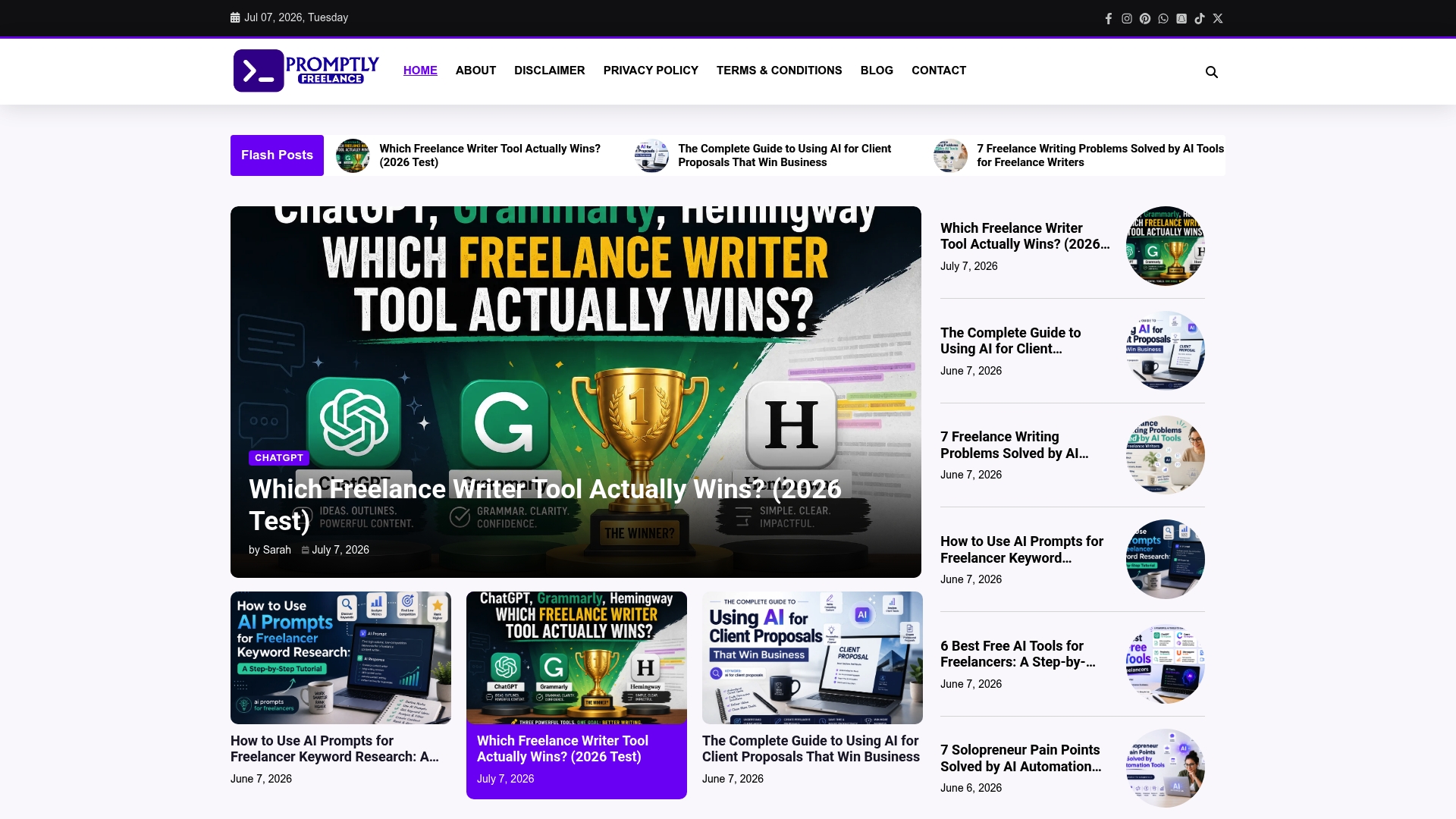
The platform is built specifically for freelancers in the US who need ready-to-use AI prompt templates across every content format: blog posts, case studies, client proposals, newsletters, and more. Instead of spending an hour figuring out how to prompt ChatGPT for a case study, you start with a template that already knows the structure. Step-by-step workflow guides cover the full freelance lifecycle, from getting your first clients to pricing your services and managing your time. Everything on the platform is free, monetized through affiliate recommendations rather than a paid subscription. If you’re ready to produce more content in less time, Promptlyfreelance is the place to start.
Key Takeaways
High-performing freelance content in 2026 matches format to funnel stage, uses AI for production efficiency, and leads with specificity rather than generality.
| Point | Details |
|---|---|
| Match format to funnel stage | Awareness needs how-to posts and short video; decision stage needs case studies and proposals. |
| AI handles production, you handle strategy | Use AI for narration, repurposing, and drafts; keep judgment calls about tone and audience to yourself. |
| Specificity drives trust | Named outcomes and before-and-after results build E-E-A-T authority that generic content never achieves. |
| Track the right metrics per stage | Measure traffic for awareness, open rates for consideration, and conversion rate for decision content. |
| Promptlyfreelance accelerates output | Ready-to-use AI prompt templates and workflow guides let freelancers produce across formats without starting from scratch. |