
Freelance marketing means working as a self-employed professional who delivers marketing services to multiple clients, without being on anyone’s payroll. You set your own rates, choose your clients, and decide how many hours you put in. The work spans digital marketing channels like SEO, social media, content creation, paid advertising, email campaigns, and analytics. Payment comes in three main forms: per project, hourly, or on a monthly retainer. Most freelance marketers work remotely, and many juggle several clients at once.
Key facts about freelance marketing at a glance:
- Self-employed, no single employer
- Serves multiple clients across industries
- Covers channels: SEO, social media, content, paid ads, email, analytics
- Payment: hourly, per project, or retainer
- Fully remote-compatible
- Promptlyfreelance offers AI tools for freelancers covering outreach, proposals, and workflow
The global digital marketing market is expected to reach $1.5 trillion by 2030, which means demand for skilled independent marketers is only growing.
Table of Contents
- What does a freelance digital marketer actually do?
- Benefits and challenges of freelance marketing
- How to get and keep freelance marketing clients in the US
- How freelance marketers structure their time and payments
- What skills do you need to succeed as a freelance marketer?
- Legal and tax basics every US freelance marketer needs to know
- Key Takeaways
What does a freelance digital marketer actually do?
The day-to-day work varies a lot depending on specialization, but most freelance marketers handle a recognizable set of responsibilities:
- Strategy development: Building marketing plans tailored to each client’s goals, audience, and budget
- Content creation: Writing blog posts, social media copy, email sequences, and video scripts
- Campaign management: Running paid ads on Google or Meta, managing SEO projects, and overseeing social media accounts
- Data analysis and reporting: Tracking campaign performance, pulling analytics, and presenting results to clients
- Client communication: Regular check-ins, project updates, and timeline management
- Project planning: Scoping deliverables, setting deadlines, and coordinating with any contractors or in-house teams
Some freelancers specialize in one channel, like SEO or paid ads. Others offer a broader mix for small businesses or startups that need one person to handle several marketing functions at once. Neither approach is wrong; the right choice depends on your skills and the clients you want to attract.
Benefits and challenges of freelance marketing
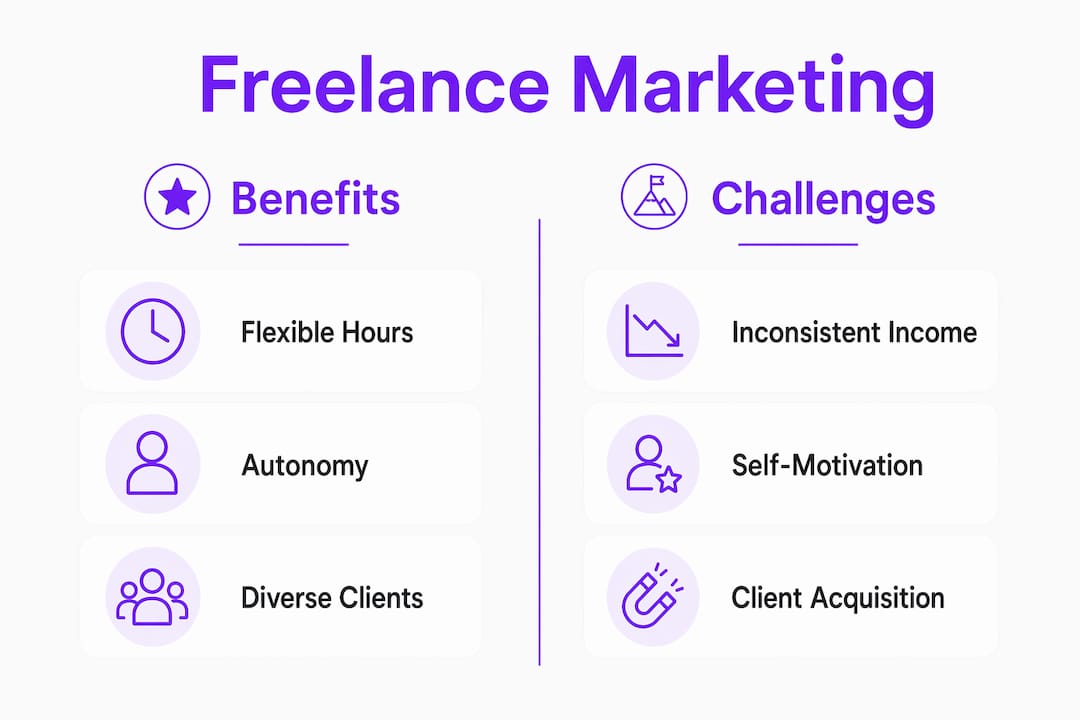
The benefits are real. Flexible hours top the list for most people. You work when you’re productive, not when a clock says to. You also get to choose your clients, which means you can drop bad fits and pursue work that actually interests you. Income potential is genuinely uncapped: as you build a track record, you can raise rates and take on higher-value projects. Freelancers enjoy flexible work hours and the autonomy that traditional employment rarely offers.
The challenges are just as real, though. Income arrives inconsistently, especially early on. The “feast or famine” cycle is common: you’re slammed with work one month and scrambling for clients the next. There are no employer-sponsored health benefits or 401(k) matches. You handle your own taxes, invoicing, contracts, and business development on top of the actual marketing work. Staying current matters too: digital marketing moves fast, and falling behind on platform changes or algorithm updates costs you clients.
The freelancers who thrive tend to be self-directed, organized, and willing to treat their practice like a business rather than a job.
How to get and keep freelance marketing clients in the US
Client acquisition is where most new freelancers struggle. A few approaches consistently work:
- Build a portfolio with case studies. One documented result beats a resume full of job titles. Show the problem, your approach, and the outcome with numbers where possible.
- Use LinkedIn actively. Connect with decision-makers, share your thinking on marketing topics, and engage with posts in your niche. LinkedIn marketing tools have become a serious channel for B2B client acquisition.
- Network in person and online. Industry events, local business meetups, and online communities all generate referrals that cold outreach rarely matches.
- Niche down. Generalists compete on price. Specialists compete on expertise. Picking a specific service for a specific type of client lets you charge more and close faster.
- Set clear contracts upfront. Define scope, deliverables, revision limits, and payment terms before any work starts. Ambiguity costs you money and relationships.
- Price on value, not hours. Once you can demonstrate results, retainer and project-based pricing almost always earns more than hourly billing.
- Report consistently. Clients who see regular, clear reporting stay longer and refer more often.
Pro Tip: Use AI automation tools for scheduling, follow-up emails, and proposal drafts. Promptlyfreelance offers ready-to-use AI prompt templates that cut the time you spend on outreach and proposals, freeing you to focus on billable work.
How freelance marketers structure their time and payments
Most freelance marketers work with a mix of clients at any given time, some part-time engagements and some closer to full-time. The payment structure you choose shapes everything from cash flow to how you scope projects.
- Hourly: Simple to start with, but it caps your earnings and creates awkward conversations when a project runs long
- Per project: Works well for defined deliverables like a website audit or a content calendar; requires a tight scope to avoid scope creep
- Monthly retainer: The most stable model; clients pay a fixed amount for an agreed set of services each month
- Performance-based: Less common but possible in paid ads or lead generation, where results are directly measurable
Negotiating clear contracts and setting payment terms upfront protects you from late payments and scope disputes. Net-15 or Net-30 terms with a deposit on new projects is a standard practice worth adopting early. Tools like freelance pricing calculators help you set rates that actually reflect your costs and target income.
What skills do you need to succeed as a freelance marketer?
No single credential is required, but certain skills separate marketers who land good clients from those who don’t.
Core marketing skills: SEO, copywriting, paid advertising, social media strategy, email marketing, and data analytics are the most in-demand. Video marketing has moved from optional to expected for many clients.

Business skills: Proposal writing, contract negotiation, invoicing, and basic project management are non-negotiable. You’re running a business, not just doing marketing tasks.
Soft skills: Clear written communication, reliability, and the ability to translate marketing metrics into plain language for clients matter as much as technical ability. Clients stay when they trust you and understand what you’re doing for them.
Certifications from Google (Google Analytics, Google Ads), Meta Blueprint, and HubSpot Academy are free, widely recognized, and worth having early. They signal credibility before your portfolio is deep enough to do it on its own.
Legal and tax basics every US freelance marketer needs to know
Operating as a freelance marketer in the US means you’re self-employed, which carries specific legal and tax obligations most employees never think about.
Self-employment tax: You pay both the employee and employer portions of Social Security and Medicare, totaling 15.3% on net self-employment income. You can deduct half of that amount on your federal return.
Quarterly estimated taxes: The IRS expects you to pay taxes four times a year, not once at filing. Missing these payments triggers penalties. Use IRS Form 1040-ES to calculate and submit quarterly estimates.
Business structure: Most freelancers start as sole proprietors, which requires no formal registration. Forming an LLC adds liability protection and can offer tax advantages as your income grows; consult a CPA before making that call.
Contracts: A written agreement for every client engagement protects you legally. At minimum, cover scope, payment terms, revision limits, intellectual property ownership, and termination conditions.
Deductible expenses: Home office, software subscriptions, professional development, internet, and equipment used for work are generally deductible. Keep receipts and track expenses from day one.
1099 forms: Clients who pay you $600 or more in a calendar year are required to send you a 1099-NEC. You owe taxes on all freelance income regardless of whether you receive a 1099.
Key Takeaways
Freelance marketing in 2026 rewards specialists who treat their practice like a business, price on value, and invest in client relationships from the first contract.
| Point | Details |
|---|---|
| Definition | Freelance marketing means self-employed professionals delivering marketing services to multiple clients without full-time employment. |
| Market growth | The global digital marketing market is projected to reach $1.5 trillion by 2030, expanding demand for independent marketers. |
| Payment models | Hourly, per-project, and monthly retainer structures each suit different client types and income goals. |
| Tax obligations | US freelancers owe self-employment tax of 15.3% and must file quarterly estimated taxes with the IRS. |
| Client acquisition | A documented portfolio, LinkedIn presence, and niche specialization consistently outperform cold outreach alone. |